
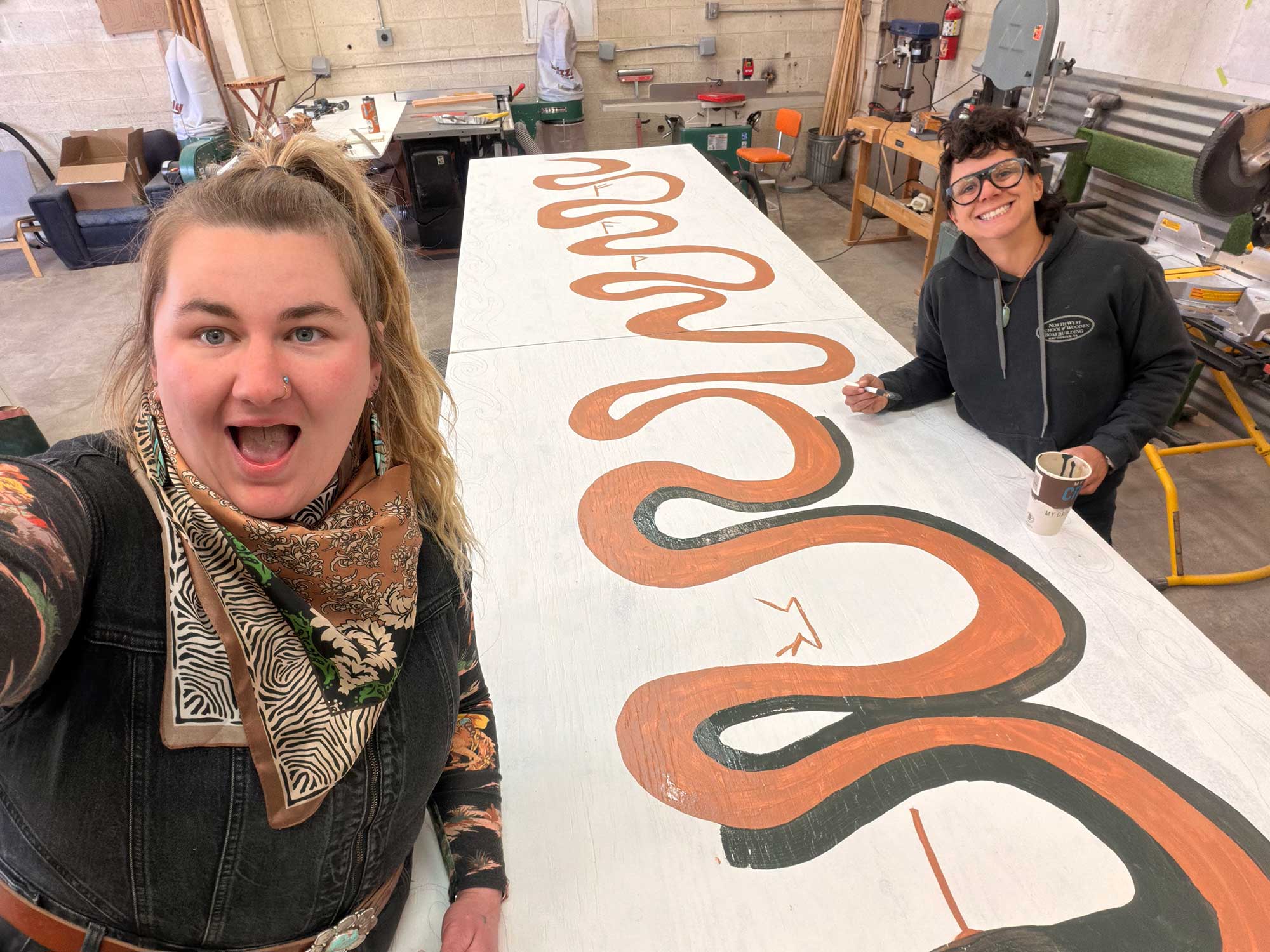
Small Craft Stories: Big Drop Boat Works
posted by
We’re on the lookout for stories from every corner of the boating world—small boat builders, fix-it shops, gear makers, and everyone in between. No matter the size of your operation, we’d love to feature you in a piece and share your story with our community. Shoot us an email at tim@smallcraftsales.com and tell us a little about yourself.
Buying an old wooden boat is a good way to acquire a project before you fully understand what you’ve signed up for. I bought Canyon Wren, a Grand Canyon river dory from the ’80s, from a friend, thinking I’d take her down the canyon on a recent permit. More on that later... That didn’t happen for a few reasons, chief among them my questionable time management skills. The work she needed and the time I had weren’t remotely compatible.
Naturally, I called THE wooden river dory shop, Fretwater Boatworks in Flagstaff, hoping to slide into their schedule. Ha! A year or more out. Worth the wait? Absolutely. Am I that patient? Apparently not. Cricket at Fretwater pointed me toward the ladies at Big Drop Boat Works in Moab, and that’s where Canyon Wren landed. They've been handling her restoration and getting intimately acquainted with everything hiding beneath the paint and fiberglass.
With that work underway, I wanted to introduce the women bringing her back. Like plenty of good river ideas, their boat shop began with beers and a conversation after a long day on the water. The question was simple: Why weren’t there more wooden dories running rivers above Glen Canyon Dam? Unlike most late-night river schemes, this one eventually became an actual business.
I caught up with Anabelle and "G" to talk about the mentors who helped them get started, the realities of opening a wooden boat shop in the desert, and their belief that beautiful boats ought to spend their lives getting used. As someone hoping to get a lot better acquainted with Canyon Wren at the oars, I’m all for that.
SCS: Big Drop Boat Works was apparently dreamt up late at night on the back of a boat after guests had gone to sleep. Can you take us back to that conversation? What were you seeing in the river world at the time, and what made you start wondering why wooden boats and dories weren’t more common in the Upper Colorado River Basin?
BDBW: We were working a commercial Desolation Canyon trip on the Green River in Utah. It had been a big day. It was super windy, we kept getting skunked on camps, and we ended up having a 30-mile day. I was rowing my first commercial dory, the only dory on the trip. After we sent our guests to bed, we were winding down, hanging out on that boat and talking about why there weren’t more dories down here. (The company we were working for only sent out one dory per trip, for special occasions, and only when “the water is high enough.”)
We sat on the boat, drank our beers and schemed about the possibility of getting more dories on the river above Glen Canyon Dam. We dreamed about what it would look like to make that happen. We laughed and discussed how challenging that would be, how much effort it would take to get our company to let us do it (build that many boats, figure out how to make it happen, influence the culture and perceptions, etc.).
After that trip, time and many river trips passed, but we just couldn’t stop thinking about it. When we’d see each other in passing between trips, we’d laugh and say, “Well, maybe someday.”
At that time, everyone ran primarily rubber boats, and they still do. The few dories that were out there commercially were a rare sight where we were, and there were often restrictions on river conditions for when dories were permitted to go out on trips. It just didn’t make sense to us, and we wanted to do something about it, like build some boats.
SCS: You mentioned that dories seemed to exist almost exclusively in the Grand Canyon, at least in people’s minds. Why do you think that is? And what made you believe those boats belonged on stretches like Cataract Canyon, the San Juan, and other Upper Basin stretches?
BDBW: Well, it all really goes back to Martin Litton. There’s a lot of history here we could do a deep dive into. Suffice it to say, and partly due to the history, I think people often think of running Grand Canyon when they think of dories. It just hasn’t been part of the picture much above the dam in recent years. I also think it has something to do with the fact that there’s more consistent water in the Canyon. But it’s all the same water above the dam as it is below. We thought, “Why couldn’t drift boats and river dories be as common up here?”
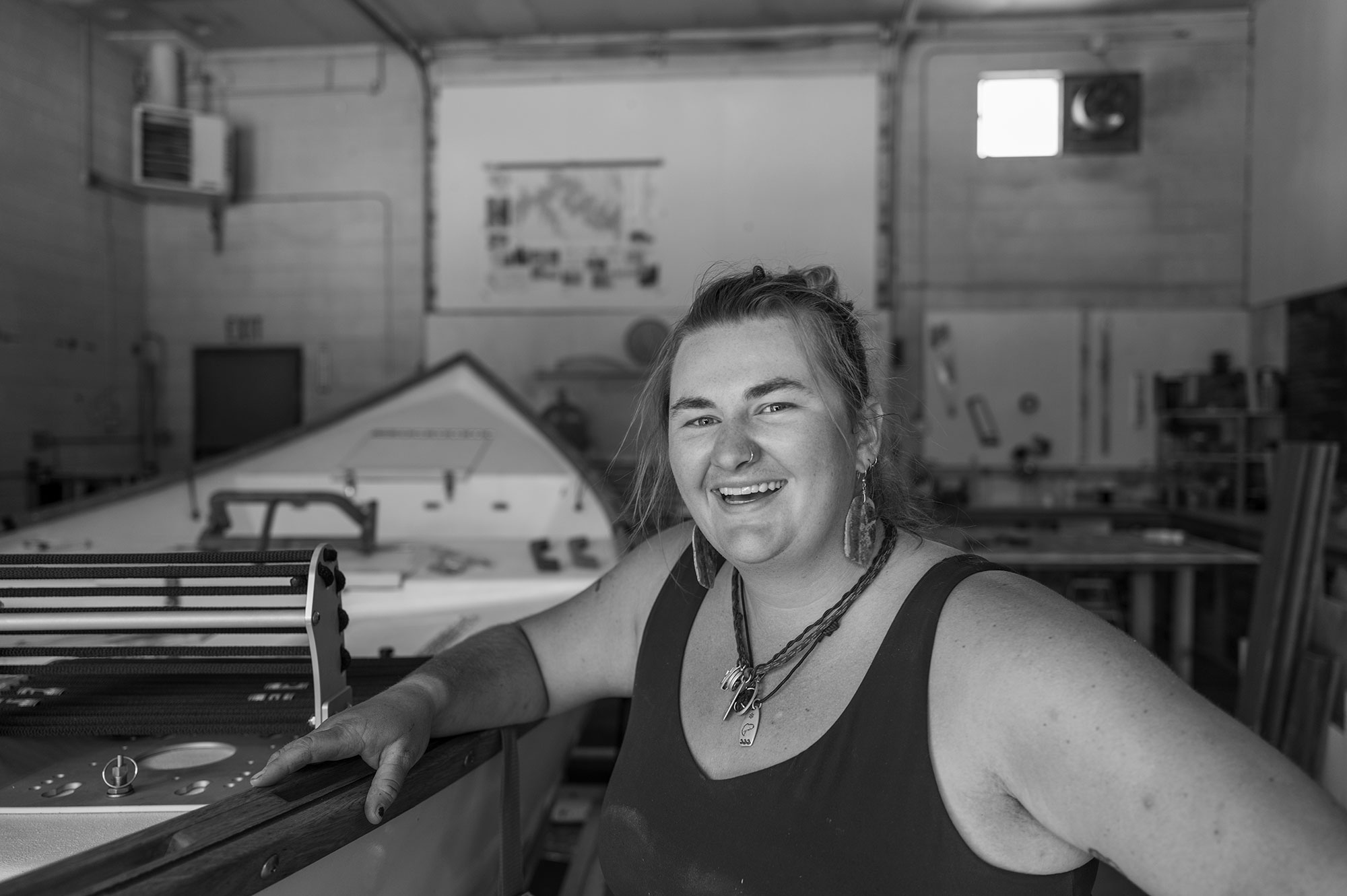
Annabelle Yeston of Big Drop Boat Works
SCS:I remember you telling me your story about maybe building “over-the-top McKenzie-style drift boats" designed for sunset charcuterie floats on the Moab Daily.” So we have to ask: how many bad/great ideas came before Big Drop Boatworks became real? Were there early versions of the dream that now make you laugh?
BDBW: The whole charcuterie idea came about as a way to justify to the company we were working for that we should be running more dories. We thought that if we could find a profitable angle to sell the trips, like a sunset charcuterie float on the Daily, maybe they’d give it a chance.
We also thought of going out on our own and basing our business out of a barn in Fruita, CO, so we could have a home base with some friends there. And it’s more affordable and not quite so hot.
We haven’t really deviated from our original idea to open a shop and build some boats…
SCS: Anabelle, you said you had all the stoke and absolutely none of the knowledge at first, while G was already at the Northwest School of Wooden Boatbuilding. What did those early days look like? How did the two of you balance enthusiasm, actual skill-building, and the slightly unhinged confidence required to start a wooden boat shop in the desert?
BDBW: While G was attending the Northwest School of Wooden Boatbuilding, I happened to run into Cricket Zarn from Fretwater Boatworks at North Wash, and she invited me to sign up for one of their classes that was being held at Lowell’s Boat Shop. Once I attended the class (Building the MacKenzie), I really caught the bug. I just couldn’t stop thinking about building wooden boats. I followed Fretwater around and took more of their classes. Cricket and Brad graciously allowed me to come play with them and learn in their shop in Flagstaff.
The rest is kind of history. It’s hard to articulate the magic at Fretwater until you experience it. We wanted to do our best to find our own twist on that kind of magic in our own shop. I try to carry a bit of their magic into what we do in our shop.
SCS: Cricket Zarn from Fretwater Boatworks seems to play a pretty important role in this story. What did meeting her mean to you? Can you talk about that first interaction, the “come play with us” invitation, and how the Fretwater crew helped pull you deeper into the wooden boat world?
BDBW: When I ran into Cricket, she had just run a wooden boat down Cat (Cataract Canyon) at 4,000 cfs, exactly what G and I had been told was impossible. I had a feeling that wasn’t true, and then I saw that Cricket had just done it. And the fact that she’s a woman doing this stuff has been super inspiring and, for me personally, has helped give me the confidence to give it a shot, too. Cricket has been a significant influence on this journey—she’s amazingly supportive and always there to advise. I’m honored to call her my friend.
SCS: You both spent time learning through places like Lowell’s Boat Shop, Fretwater, Tsé Kooh, and the Northwest School of Wooden Boatbuilding. How did those different experiences shape what Big Drop Boatworks is today? What did you take from those communities, shops, and teachers that now shows up in your own boats and repairs?
BDBW: Well, we obviously learned a ton—different techniques and many different philosophies and ways to do things. It’s helped us pick and choose what works best for us. And at the Northwest School of Wooden Boatbuilding, which we attended, we primarily worked on ocean-going vessels, so that gave us yet another great perspective.
G’s experience at Tsé Koo, building San Juan River punts, really gave her the opportunity to experiment with different designs and techniques, which really adds a ton to what we’re doing at Big Drop.
The one commonality in all of the programs is a passion for wooden boatbuilding. And it tends to be infectious.
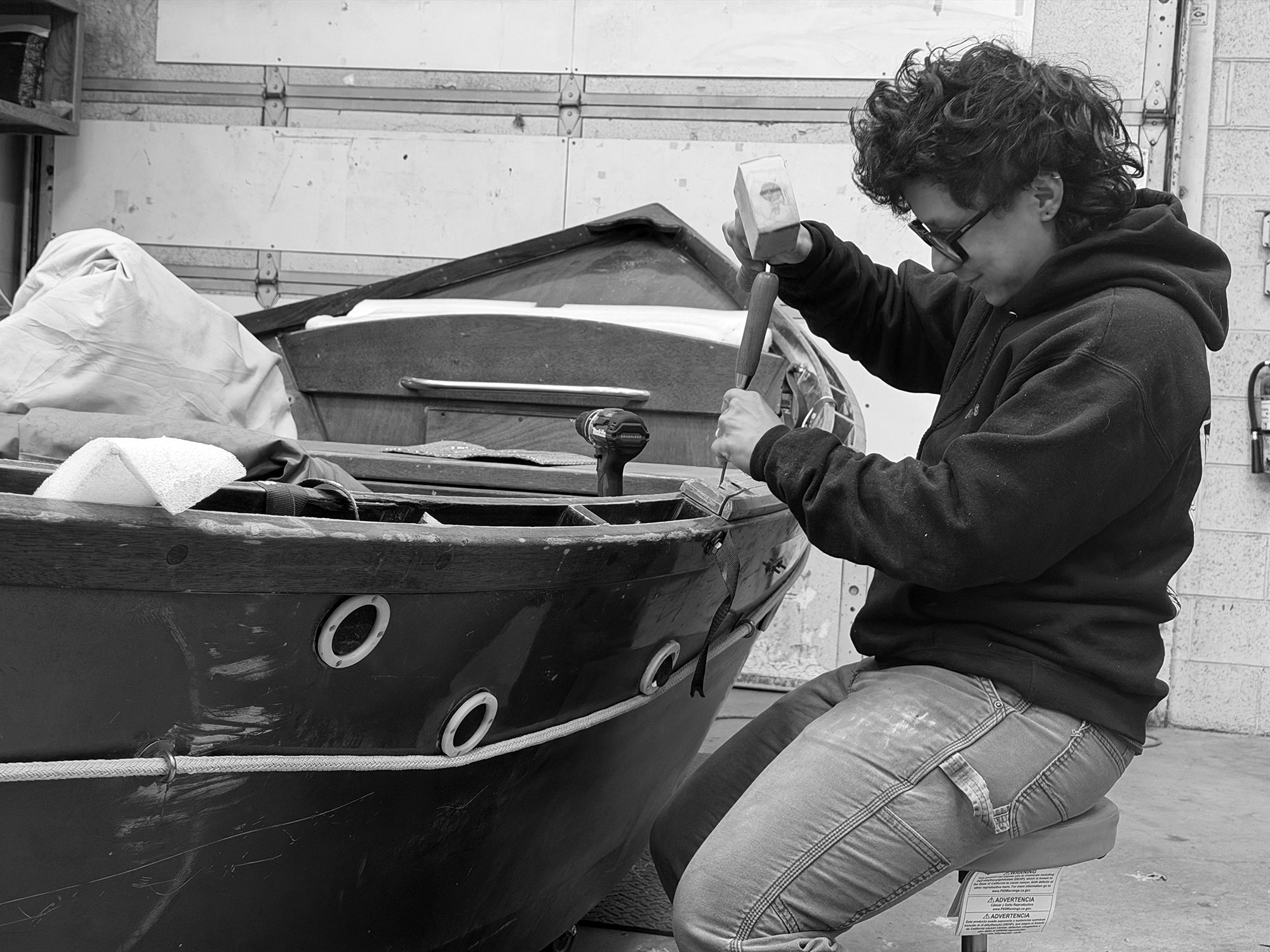
Co-Owner "G" getting after it with a mallet in the shop.
SCS: There’s something pretty powerful going on here. What is it about wooden boats that gets under people’s skin? Is it the history, the way they row, the repairability, the romance of it all, or some combination that’s hard to explain until you’re in one?
BDBW: I think it’s a combination of it all. And the history. For me, personally, having worked for years as a river guide on whitewater, I feel like in a wooden boat you’re just more connected to the river. In a wooden boat, it’s all about subtlety and nuance, and you can’t just go down the river running into shit. It’s beautiful and elegant and requires a deeper connection to the water.
And as a fishing boat, you can maneuver a McKenzie fishing boat so much more easily than a rubber raft—you can sneak into micro eddies to fish the perfect spot and basically slip around wherever you want. You can even go back if you pass a good spot.
In addition to being maneuverable and elegant, a wooden boat is durable. And if you do crash into something, it’s usually pretty straightforward to repair.
SCS: Big Drop Boatworks is focused on building and repairing drift boats and river dories for the people of the Upper Basin. What does an Upper Basin boat need to be? Or is it any different? How do rocks, low water, desert heat, long shuttles, big rapids, fishing days, and multi-day trips influence the way you think about design and durability?
Well, we’ll happily build or repair a boat for anyone, anywhere. We want to see them everywhere. They are the perfect boats for Upper Basin conditions.
BDBW: Basically, when we build or repair a boat, our idea is that we make the boat what the person wants/dreams it to be, within reason. There’s so much opportunity to personalize and experiment. We want to build boats that are beautiful and functional at the same time. And then we want people to use the boats (fish, work, explore, learn, live in them), not just keep them in their garage. These boats are meant to be on the water! A lot.
SCS: Starting a boat shop sounds dreamy from the outside, but you mentioned city hoops, tears, laughter, and finally repairing your first boat. What has the reality of opening Big Drop Boatworks been like so far? What has surprised you most about turning the late-night river-trip dream into an actual working shop in Moab?
BDBW: Well, we learned that it’s hard work to start a business. We were surprised at the amount of bureaucracy you have to get through before you can even call yourself a business (business licenses, inspections, insurance, taxes, how to handle actually conducting a transaction). It’s definitely been a huge learning experience beyond the actual work we do with wooden boats. Everything, especially at first, takes a lot longer than you anticipate.
And it’s been illuminating developing the ability to juggle our other jobs, personal lives, relationships and our own private river trips. We now know that if you let the long to-do list control your life, you’ll never get anything done.
But it’s been an exciting and overall positive experience. We’ve learned a ton. And it’s fun and rewarding. I think we’ve finally found our flow, and we’re getting pretty comfortable reading the water ahead of us.
SCS: Bonus closer: Five years from now, what would make you look around the shop and say, “Yep, this worked”? More dories in Cataract? A growing Upper Basin wooden boat community? A full repair calendar? A weird charcuterie drift boat after all? What does success look like for Big Drop Boatworks?
BDBW: Honestly, a huge part of this for us is staying connected to the river when we’re not able to actually be on it, especially in the winter. We want to see more wooden boats out on the water. We want to see this craft flourish and share our passion for wooden boats with as many people as we can. I’d say that if we’ve done that, we can say, “Yep, this worked.”
Get in touch with Big Drop:
420 Kane Creek Blvd, Moab, UT 84532
bigdropboatworks@gmail.com (970) 417-7305