
Small Craft Stories: Laborer, Craftsman, Artist — The Work of John O’Connor (RiverGuideGear)
posted by
We’re on the lookout for stories from every corner of the boating world—small boat builders, fix-it shops, gear makers, and everyone in between. No matter the size of your operation, we’d love to feature you in a piece and share your story with our community. Shoot us an email at tim@smallcraftsales.com and tell us a little about yourself.
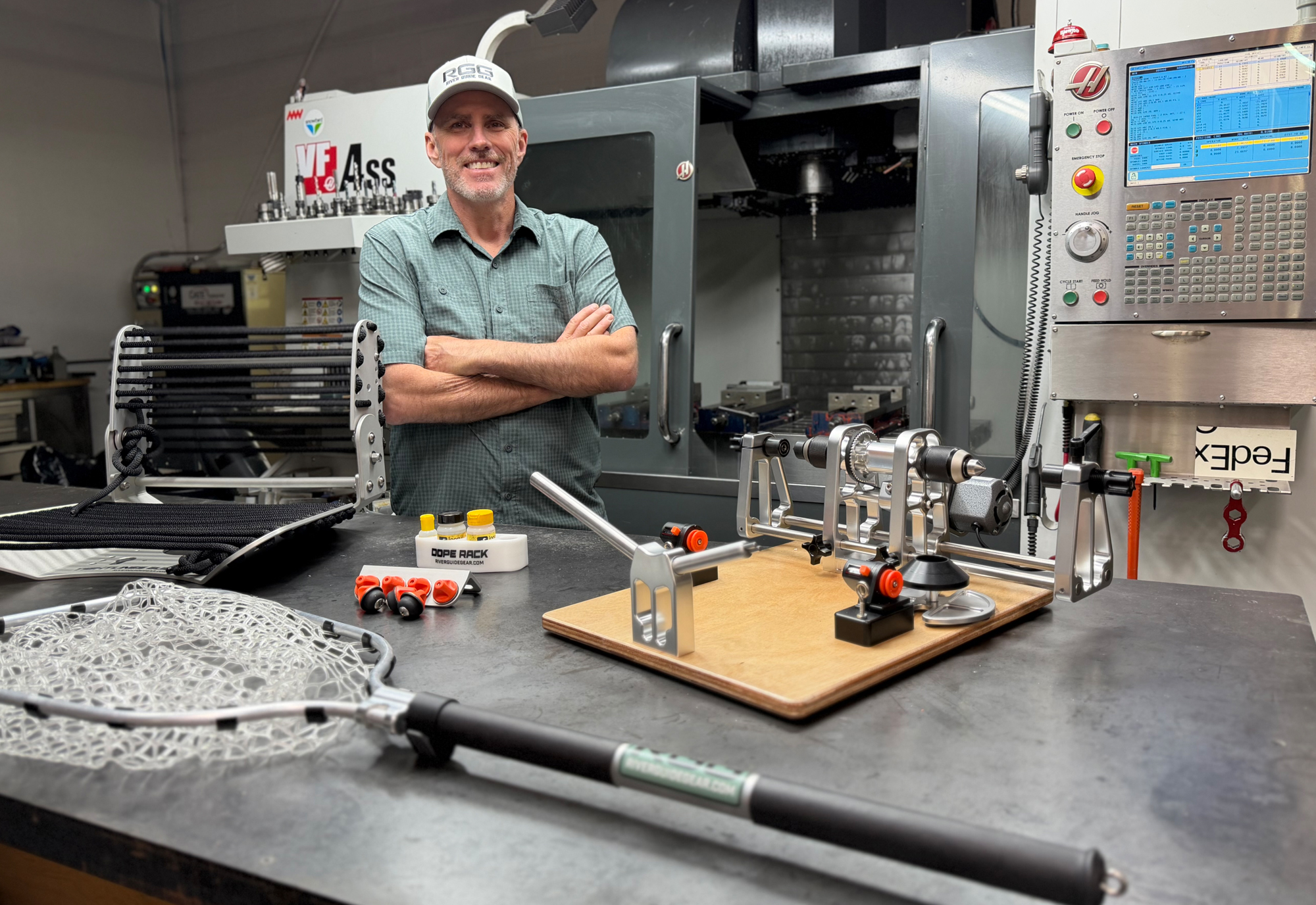
I met John O’Connor of RiverGuideGear this past winter at the Denver Fly Fishing Show. His booth was somewhat inconspicuously tucked just off the main floor near the entrance, but it didn’t stay unnoticed for long. I was immediately drawn to the incredibly sexy rope seats he makes for dories and drift boats as I’m partial to seats of this style and honestly hadn’t seen anything quite like them before. The craftsmanship was obvious right away. These are beautifully machined, thoughtfully designed, and built to be used. Then I started noticing everything else on the table: trailer kickstands, “no-snag” drain plugs, seat quick-releases, something called the Shuttle Safe, nets, oar docks, and probably the best designed fly-line winder I’ve ever seen. All of it executed to immaculate standards. Naturally, I had questions.
John, it turns out has spent a lifetime building things with his hands. Raised in Rhode Island, he was fishing and experimenting with homemade gear before he was a teenager, even crafting an early fly rod from brittle reeds that forced him to develop a smooth casting stroke just to keep it intact. His path has included everything from shaping surfboards and working aboard a wooden yacht to co-founding an OEM snowboard manufacturing company in the mid-90s and ultimately becoming a machinist, where precision tools became both his creative outlet and professional language. Today, fly fishing, drift boats, camping, and overlanding provide the inspiration for the thoughtfully designed gear he produces, all rooted in a lifelong drive to create and refine functional objects that reflect both craftsmanship and purpose.
When asked what John considers himself, he replied: “the common thread throughout my life is a need to create. I've been called an artist, and it's never sat well with me. I read something recently that shifted my perspective. Someone that works with their hands is a laborer. Someone that works with their hands and their brain is a craftsman, while someone who works with their hands, their brain, and their heart is an artist. This allowed me to make peace with the term."
Small Craft Sales: First things first… what exactly is River Guide Gear? How do you describe it to someone who has never spent time around rafts, frames, or gear piles?
Simply put, With RGG, I am trying to reimagine and refine every aspect of fly fishing from a boat. From the trailer hauling the boat to the seat you sit in on those hot summer days, to loading backing on a reel. I refuse to accept the, "this is how we've always done it" way of thinking. Tradition has its place for sure but there's nothing wrong with making new traditions either.
SCS: Let’s start at the beginning. How did River Guide Gear come to life? Was there a specific moment on the river when you thought, “Why doesn’t this piece of gear exist?”
River Guide Gear: RiverGuideGear was born after I purchased my first boat, A three man FlyCraft. I reconfigured my seat to be able to slide back and forth for different rowers as well as adding dedicated stepping locations along the frame. After I learned how to row a bit I decided I wanted a proper dory and I purchased a Hyde drift boat. Now… I have to say that after spending any time doing almost anything, I zero in on the things that bug me or seem to me to be obviously inefficient. I find the "How" I do something to be as important as "what" I'm doing. I like to innovate and that's the space where innovation lives.
SCS: Were you a tinkerer growing up, or did problem-solving come out of necessity after something broke mid-trip? I know you’ve machined other high-end equipment in the computer world, right?
RGG: I have been tearing things apart to see how they work my entire life. Starting with taking a Hack saw to a sofa arm or a hammer to my bedroom wall to see what's inside and how does it work?
I have been very fortunate to have found a career that I love that lets me flex almost every aspect of my personality while earning a living. The most recent and relevant career path change happened in about 2004. I set up 2 snowboard factories, one in 1995 and the second being the Voile SplitBoard factory around 2000. After a few years of doing that, Voile needed an in-house design and development person as well as someone to produce and maintain their tooling. I negotiated a deal with my boss for a paid apprenticeship under his Tool and Die guy which lasted a little over two years. I had privileges to use the shop on nights and weekends and used that time to learn CNC machining. I bought my own CNC some years later and started making custom parts for a medical designer friend, titanium jewelry, and an Apple Laptop accessory called the inclinepro. As time went by my business had more growth in producing custom parts for medical and aerospace companies, so I concentrated on those clients and dropped my hobby businesses.
SCS: River folks are famously creative when it comes to gear hacks. What was the first piece of equipment you built that made other river people say, “Wait… where did you get that?”
RGG: I couldn't agree more. We all travel to remote locations and need to have a healthy number of creative solutions to unforeseen equipment failures or gear we forgot to bring. Necessity being the mother of invention. Almost everything I've ever made for myself has been the source of that "hey, where did you get that?" question. A lot of people are drawn to the brutalist, industrial aesthetic of most of the things I make. Form following function kinda stuff. The Tightlines Guide Seat is the first piece of river related gear that I got asked about and still do almost every time I launch the boat.
SCS: Many of your products feel like solutions to very specific frustrations that only show up after many days on the water. How much of your design process comes directly from real-world on water experience? If not, where else does it come from?
RGG: I suppose that for many, it may take many days, but I find that a part of my brain is always analyzing and seeking refinement. I would say that all my designs come from real world experiences. I lean heavily on thought experiments where I use my idea mentally until I can "see" it in its entirety functioning in the real world. Then I will sit down, draw it up on my computer and turn on my CNC and gram some material.
SCS: A lot of the best river gear is deceptively simple. What makes a product “done” for you? When do you know you’ve nailed the design?
RGG: One man's 'seems simple' is another man's waking up at 3am with a eureka moment and then lying there running that idea through the entire design. Looking for incompatibilities with use, material, and design parameters. What's that saying, success looks a lot like hard work in the rear-view mirror? Same can be said of a simple design. You nailed it in your question when you said deceptively.
I don't know if there is such a thing as done. To say that is to assume you've created something perfect, and I don't believe perfection can be attained. I only start a design project if I have something to offer and I stop when it feels right. At RiverGuideGear, I reach out to a few guides whom I respect with my designs and ask for feedback to shed light on my blind spots. I truly want RiverGuideGear to be a collaborative process. I feel that will produce the best products.
I don't know if I ever get to the "nailed it" part. I always like to leave that door cracked.
SCS: Do you design with outfitters in mind, private boaters, anglers… or all the above?
RGG: I design with everyone in mind. I focus on the guides because they are the best test bed for ideas since they have the most experience and spent the most time on the water. I figure if it can make their lives easier and hold up, it will help the weekend warrior no problem.
SCS: What’s the piece of gear in your lineup that people don’t fully understand until they use it?
RGG: Man... I have no idea. My friend Bryce Nichols would say the DriftLift. He frequently expresses how he can't understand why every boat trailer doesn't have one. Sure, a 2x4 will do the job but with the DriftLift I never have to concern myself with kids playing in or around my boat and no wind can knock it down. I guess it's about priorities...
SCS: We agree!
RGG: Second would be the LineLathe. I designed the first one for Western Rivers Flyfisher after I purchased a new Hatch reel and watched my salesperson fuss with their 35-year-old machine while he tried to get my reel mounted and centered enough to load the backing and line. In true "Me" fashion, I told them I was going to make them a winding machine. I'm certain they thought I was crazy and dreaded the day I showed up with something cobbled together. After a few morning coffee discussions, I set to work and once I saw it working in my mind, I started cutting metal and buying parts. Sure, I embellished a bit on the design as it was going to be in public, and my ego demanded it look as good as it functioned. I am extremely proud of what was delivered. After a few refinements to the initial machine, I feel the LineLathe is second to none. I think people don't understand that it is first and foremost a tool. I believe it is a tool that not only does its job quickly, but also a tool that ultimately makes shops money and helps them provide customer service for those customers who frequently travel and bring their reels in for post trip clean up and service.
SCS: What problem on the river still annoys you that nobody has solved yet?
RGG: While not necessarily "on" the river, oar storage while traveling is a pet peeve. I just got a new boat and I'm working on a solution to that as we speak. Oars aren't inexpensive and I want to protect that investment for myself and others.
SCS: Your products live in that interesting space between safety gear, efficiency tools, and quality-of-life upgrades. How do you balance innovation with reliability?
RGG: Thank You, I've never thought about those intersections. I think there is space in all of those areas for improvement and sometimes an upgrade in one can have an unintended ergonomic or safety upgrade in another. I'm not going to sit here and say that that doesn't happen a lot but with my approach to design, I think there is fertile ground for those coincidences to happen.
SCS: Has anything you built ever surprised you in terms of how people ended up using it?
RGG: When I first showed the folding version of the TightLines Guide seat to my friend Matt Lucas of Western Rivers Guides, he immediately jumped up, folded the seat back down, and sat on it. "I want to be able to sit up here too" he said… It was so obvious and it never occurred to me to have a “boost” feature like wakeboarding boats do. Privately, I refer to it as the Matt Back. This is a prime example of how leaning on experience can steer a design to a much better place.
SCS: What does your prototyping process look like? Shop tinkering? CAD? Napkin sketches? Garage chaos?
RGG: I am so bad at the napkin thing... Because of my experience making injection molds, I need to be able to conceptualize things in 3D, inside out, in reverse. Listening to me verbally describe an idea must be a very painful experience. Especially if I'm excited. Trust, if you think I talk fast, know that my brain left the chat minutes ago. I'm already working on it... It's a process.
SCS: How many versions of a product typically exist before the public ever sees it?
RGG: If you are in my inner circle you'll see a prototype in very short order. Because of my day job, I need to be able to go from concept to part rapidly and this has really helped me with my little RiverGuide Gear business. As I mentioned before, I won't even start cutting till I see it and have worked with it mentally. Sometimes, I hit a home run but more times than not a few tweaks are needed. I can say that most times there were one or two versions before the final one. It's more common that while i'm making the first prototype, I'll see a better version and scrap everything and start over. It happened today!
SCS: What’s the harshest real-world testing environment your products have survived?
RGG: Hands down, anything you hand Matt Lucas. Next!
SCS: Are most of your ideas born from your own needs, or from conversations with other guides and boaters?
RGG: Both. I love that I have a group of very clever people I spend time with. Conversations will usually include a what if session, especially now that RGG is happening. I am approached often now as people see RGG as a tool in their quiver.
I am in a way very selfish and seek to remedy things I can't stand for betterment of my own experience. Fortunately, once I do something about it, folks chime in with their displeasure about the same damn thing. As my good friend Ryan Lewis likes to say, "John fixes things we didn't even know were broken yet". I take this as a huge compliment.
SCS: Do you think the modern raft frame and rigging setup has peaked, or are we still in the early innings of innovation?
RGG: Man, I have very limited experience in the rafting world, but when I see what Abstract and Letmrun are doing with their fiberglass inserts as frame replacements I'm impressed. Such efficient use of the limited space. Perhaps it wouldn't be desirable in whitewater applications but for fishing it inspires me.
SCS: River culture has always valued DIY solutions. How do you maintain that spirit while producing finished products for sale?
RGG: Since it's just me at RiverGuideGear doing all the manufacturing locally, I feel my designs retain some of that DIY spirit.
Funny, but aren't most DIY solutions born from either "no one makes it" or "someone makes it but I don't wanna spend that much"?
I get it, honestly, I do. Manufacturing anything domestically costs more and if you insist on premium materials and processes like I do, it produces a costly product. Why do I choose the word costly and not expensive you ask? An expensive item, in my opinion, has a high price tag and either fails to perform as advertised or requires replacement because it didn't last. A costly product's price reflects the materials and processes required to produce a product that both delivers on performance and longevity. I grew up fixing things with my dad, and I despise the disposable society we've become. Everything I make can be repaired to protect your investment long after I'm not around.
SCS: Do you approach design differently for multi-day expedition gear versus day-trip setups?
RGG: Most of what I design and make is intended to be used daily. I concentrate on proven design languages to produce durable/overbuilt products. I am trying to create a company that doesn't have or require a warranty department but rather a parts department that will install the parts for you if needed.
SCS: What’s something only experienced “guide types” tend to notice about boat setups that newer boaters might miss?
RGG: I am not a guide so I can only offer an opinion. From what I've seen, a guide optimizes his boat, so it only has what they feel is necessary to guide a guest for the day. Their boats are tools and the best tool for that job is as light and durable as possible. People such as myself view my boat as a place to spend time with my friends as often as possible. Since I can't do it as often as I'd like, I want to be comfortable and not feel cramped, so I have a larger boat than most, almost 17' long. While a guide might appreciate my boat, he'd probably never want to row it every day.
SCS: Have advances in materials changed what’s possible in river gear design?
Apart from some really high tech ropes, I try to stick to materials I know and have a lot of experience with. I'll leave the exotic material integration game to the rod and boat manufacturers. I would however like to do a carbon fiber seat.
SCS: What’s the most underrated part of a well-rigged boat?
RGG: That's a better question for a guide but I'd say a good net and more importantly, a good place to put it. I am working on those two things right now… Stay tuned.
SCS: If you could redesign one common piece of river equipment from scratch, what would it be?
RGG: I'd love to build and outfit boats from A to Z. I have some strong ideas I'd love to see come to life.
Too many ideas and not enough resources.
SCS: What do you enjoy most about designing gear specifically for the river community?
RGG: Having a customer tell me that something I dreamt up and made allowed them to have a better experience is why I do what I do.
SCS: What does a perfect river day look like for you when you’re not thinking about gear?
RGG: So many ways it can be perfect...
For me the entire reason for doing any of this is sharing the experience with friends. New ones, old ones, it doesn't matter. Look where we are?! Look what we get to do!
Oddly enough, some of the best days I've ever had on the river included shit weather. Now I know fishing is a foul weather sport but something about surrendering to the elements and just letting go and being present... It's indescribable. I find myself thinking about those days and the people I was with more often than the "perfect' days.
SCS: And finally… what problem are you hoping to solve next?
I'm sure I'll be meeting that next problem real soon but for now, I'm finishing up on a line of nets that will be available later this spring.